The short version
On roads with a speed limit of 60 km/h or less, drivers of other vehicles must give way to a bus when it is signalling to leave a bus stop and enter the traffic stream.
- Effective date: 1 October 2026
- Applies where the posted limit is ≤ 60 km/h
- The bus must be indicating its intention to move off
- Bus drivers still have duties: mirrors, indicate in good time, and pull out only when traffic is giving way
This page summarises public NZTA / government announcements for learners. Always check the official NZTA page linked at the bottom. Last checked: 21 September 2026.
What’s changing
Until this rule takes effect, many drivers already thought they had to let buses out - but it was largely treated as courtesy, not a clear legal duty in the Road User Rule.
From 1 October 2026, on lower-speed roads, other traffic must give way so buses can rejoin the lane after stopping. The aim is more reliable public transport and clearer expectations for everyone sharing urban streets.
Don’t mix this up with bus vs transit lane questions. Those are about who may use the lane. This change is about who gives way when a bus leaves a stop.
When the duty applies
Speed limit
The legal give-way requirement applies on roads with a posted speed limit of 60 km/h or less - typical town and city streets, not open-road speeds above that.
The bus must be signalling
You give way when the bus is indicating its intention to enter the traffic stream. If the bus isn’t signalling to move off, this new duty doesn’t kick in the same way - but you still drive carefully around buses and passengers.
What “give way” means
Same definition as the rest of the Road Code: the bus shouldn’t need to stop, brake or slow down, swerve, or take other evasive action because of you. Slow, leave a gap, and let it merge when it’s indicating.
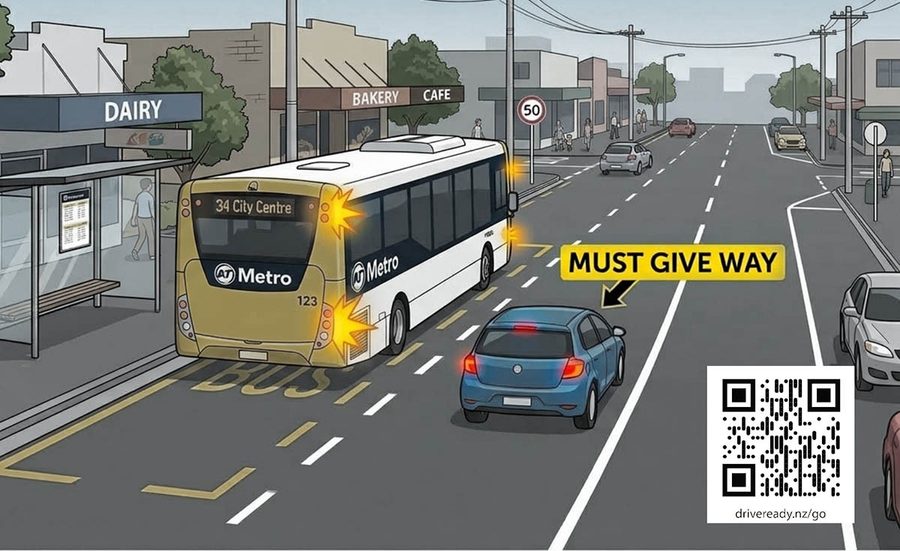
What other drivers must do
- Watch for buses at stops on streets 60 km/h or under
- When the bus is indicating to leave the stop, give way so it can enter your lane safely
- Expect larger vehicles to need more space and time - don’t squeeze past at the last second
- Stay calm: this is everyday urban driving, not an emergency stop for every stationary bus
Theory trap: Thinking the rule applies on every road, including open-road 80-100 km/h limits. It doesn’t - the confirmed requirement is for roads 60 km/h or less.
What bus drivers must do
The new rule doesn’t give buses a free pass to pull out blindly. Before moving off, bus drivers are still expected to:
- Check mirrors and blind spots
- Indicate clearly and in good time (existing Road User Rule requirements still apply - including indicating for long enough before moving)
- Confirm traffic is giving way
- Enter traffic smoothly and safely
For learner theory: if a question mentions a bus leaving a stop and indicating on a ≤60 km/h road, other traffic gives way - but the bus still has to indicate and move off safely.
Courtesy vs law - and other lane-use changes
Many Kiwis already let buses out. From 1 October 2026, on ≤60 km/h roads, that behaviour is aligned with a clear legal expectation, not just good manners.
The wider “lane use improvements” package also covers other road-user changes (for example minimum passing gaps for vulnerable road users, and where e-scooters may ride). For Class 1 learner theory, the bus give-way rule is the one most likely to show up in “who must give way?” style questions - practise it alongside the rest of the give way rules.
How DriveReady covers this
DriveReady NZ’s question pool already includes the October 2026 bus give-way rules. We keep Road Code content current over the air, so you’re practising today’s test material - including this change - not last year’s courtesy-only wording.
- Drill give-way diagram and scenario questions
- Use exam-style mocks to check you’re consistent
- Clear misses with review mistakes before you book
FAQ
When do I have to give way to a bus leaving a stop?
From 1 October 2026, on roads with a speed limit of 60 km/h or less, when the bus is signalling to leave the stop and enter traffic.
Does the bus have to be indicating?
Yes. The duty is tied to the bus indicating its intention to enter the traffic stream. Bus drivers must still indicate clearly and only pull out when it’s safe.
What about roads above 60 km/h?
This specific legal requirement is for roads 60 km/h or less. Drive carefully around buses everywhere - but don’t invent a blanket open-road give-way duty that isn’t in the confirmed rule.
Does DriveReady include this rule?
Yes - the app already includes October 2026 bus give-way coverage in the up-to-date question pool.